Your new waste collection schedules will be delivered between late October and early November.
In the meantime, you can view your schedule online or pick it up at City facilities.
The official website for the City of London, Ontario
The next municipal election will be held on Monday, October 26, 2026, with voting hours from 10 a.m. to 8 p.m.
Advance Voting will take place on the following dates and times as listed below:
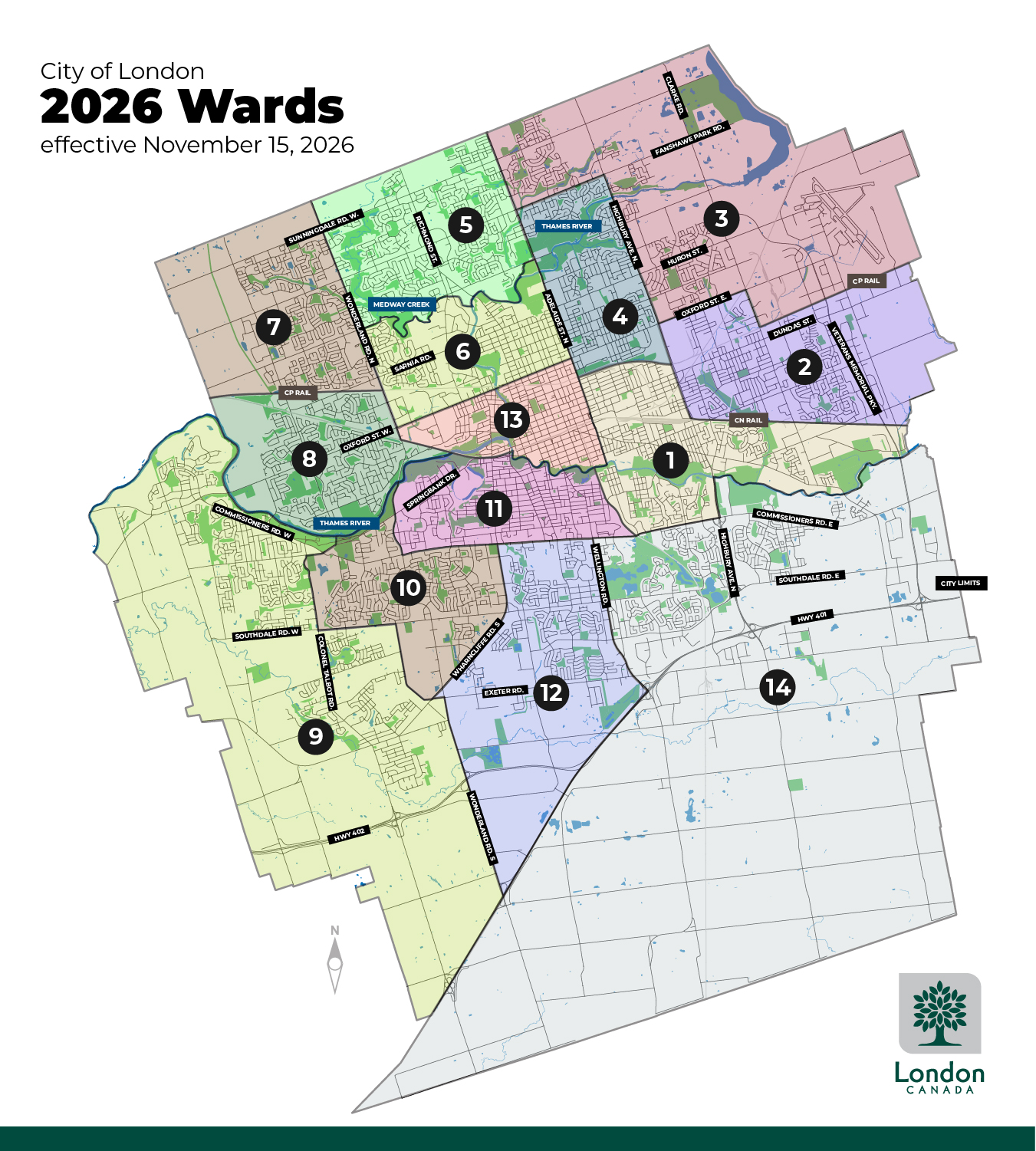
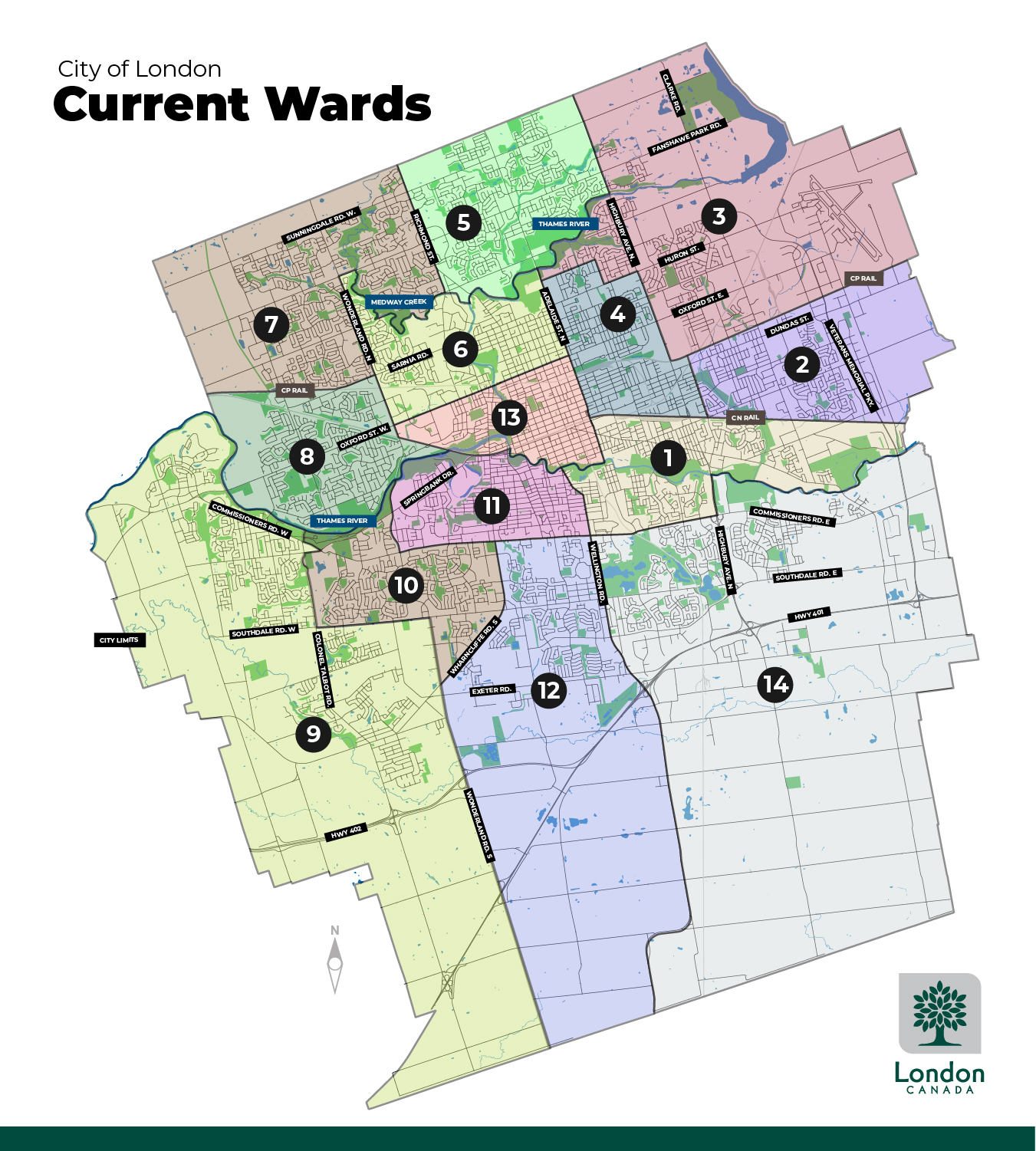
London’s ward boundaries are changing for the upcoming municipal election on Monday, October 26 to reflect the city’s growing population.
As a result, you may now live in a different ward than before.
Don’t guess — know where you’re voting.
The City of London is committed to providing alternate formats and explanations of the revised Ward Boundary map. To request an explanation, please contact elections@london.ca or call 519-661-4535.
The City of London has completed its 2024 Ward Boundary Review. The Final Report and Recommendations were presented at the December 10th Strategic Priorities and Policy Committee meeting, where Council approved, in principle, Final Option 1 from the 2024 Ward Boundary Review – Final Report.
This meeting included a public participation session, during which residents and community groups shared their insights and feedback. Based on this input, the Council incorporated three minor amendments to reflect communities of interest better and ensure a balanced population distribution. These changes affect Wards 1, 4, 11, and 13.
At the December 17, 2024 Council meeting, Final Option 1, as amended, was officially approved.
What are the Ward Boundary changes?
The City of London completed a Ward Boundary Review in 2024 to ensure fair and effective representation across all 14 wards. Based on this review, new ward boundaries were approved by Council that redistribute the city’s population more equitably among wards.
When do the new ward boundaries take effect?
Residents will vote using the new ward boundaries on Monday, October 26, 2026. However, the new boundaries do not come into effect until November 15, 2026, when the new Council term begins. Until that date, your current ward and Councillor remain unchanged.
Will the number of wards change?
No. London will continue to have 14 wards, each represented by one Councillor, plus a city-wide elected Mayor.
Why were the ward boundaries reviewed and changed?
As London continues to grow, ward boundaries must be reviewed to ensure fair representation for residents across the city, while keeping neighbourhoods together where possible and respecting natural and built boundaries.
How were residents involved in the Ward Boundary Review?
The review included public and community engagement, such as, public participation meetings, public sessions, and consultations with community groups, residents, and local institutions. This feedback helped shape the final recommendations presented to City Council.
How will these changes affect voters?
For the 2026 election, voters will receive ballots based on the new ward boundaries.
Your current Councillor and ward remain unchanged until the new term begins on November 15, 2026.
If you aren’t sure which new ward you will vote in, use the interactive ward map.
How will the 2026 ward boundaries balance established neighbourhoods and communities?
During the 2024 Ward Boundary Review, the consultant and project team gathered data, listened to feedback, and engaged with the public to understand local communities. This information helped us review population distribution and develop proposed ward boundary options. The team used this input to reflect community feedback while ensuring the proposed changes followed the guiding principles set by the City of London.
How do the 2026 ward boundaries account for the student population?
Post-secondary students were included as part of the population analysis for the Ward Boundary Review and were added to the Census population when analyzing population distributions. As presented in the Population, Housing and Employment Growth Projection Study, 2021–2051 by Watson & Associates Economists Ltd., dated October 17, 2022, the post-secondary student population not captured in the 2021 Census was estimated at 24,400. The Census population for the City of London in 2021 was estimated at 422,320, excluding post-secondary students, for a total estimated population of 446,750 as of 2021. This total was used as the basis for the study. Due to recent policy changes related to international student enrolment across the country, the consultant team did not account for further post-secondary population growth in the Ward Boundary Review study and held that number stable at 24,400 through the next two election cycles.
How do these changes affect candidates?
Candidates for council and school board trustees will file nominations and campaign based on the updated ward boundaries for the 2026 election.
Who can I contact for more information?
If residents have specific questions not answered here, they can contact the Elections Office for election and ward information.