Your new waste collection schedules will be delivered between late October and early November.
In the meantime, you can view your schedule online or pick it up at City facilities.


Coordinated Informed Response (CIR) is a trained, highly-engaged team of City of London employees, London Police Services and contracted outreach agencies. CIR is on the streets and in the community every day, offering support and services to Londoners living unsheltered. This team also works closely with London businesses to help address challenges related to individuals that live unsheltered.
If you notice an encampment in your neighbourhood, please do not enter the area yourself. If someone appears to be in danger or there is a violent situation, call 911 immediately. For other concerns, you can report an issue through the Service London online portal, over the phone by calling 519-661-4570, or by emailing service@london.ca.
Preventing injury, illness, and loss of life for people living in encampments and people that live or work near encampments is critically important. While even a single encampment can present risks to be addressed, anytime there is a concentration of tents in a single space, the risk factors are even greater. To assist people living in encampments, the City of London has established clear parameters of what is acceptable and what is not acceptable as it relates to locations of encampments, the number of structures in encampments, and various behaviours of people in encampments.
The following information captures the operating considerations to promote safety for people living in encampments and neighbours.
The following map identifies locations where encampments are proactively enforced. These are mixed use spaces that are regularly utilized for multiple purposes.
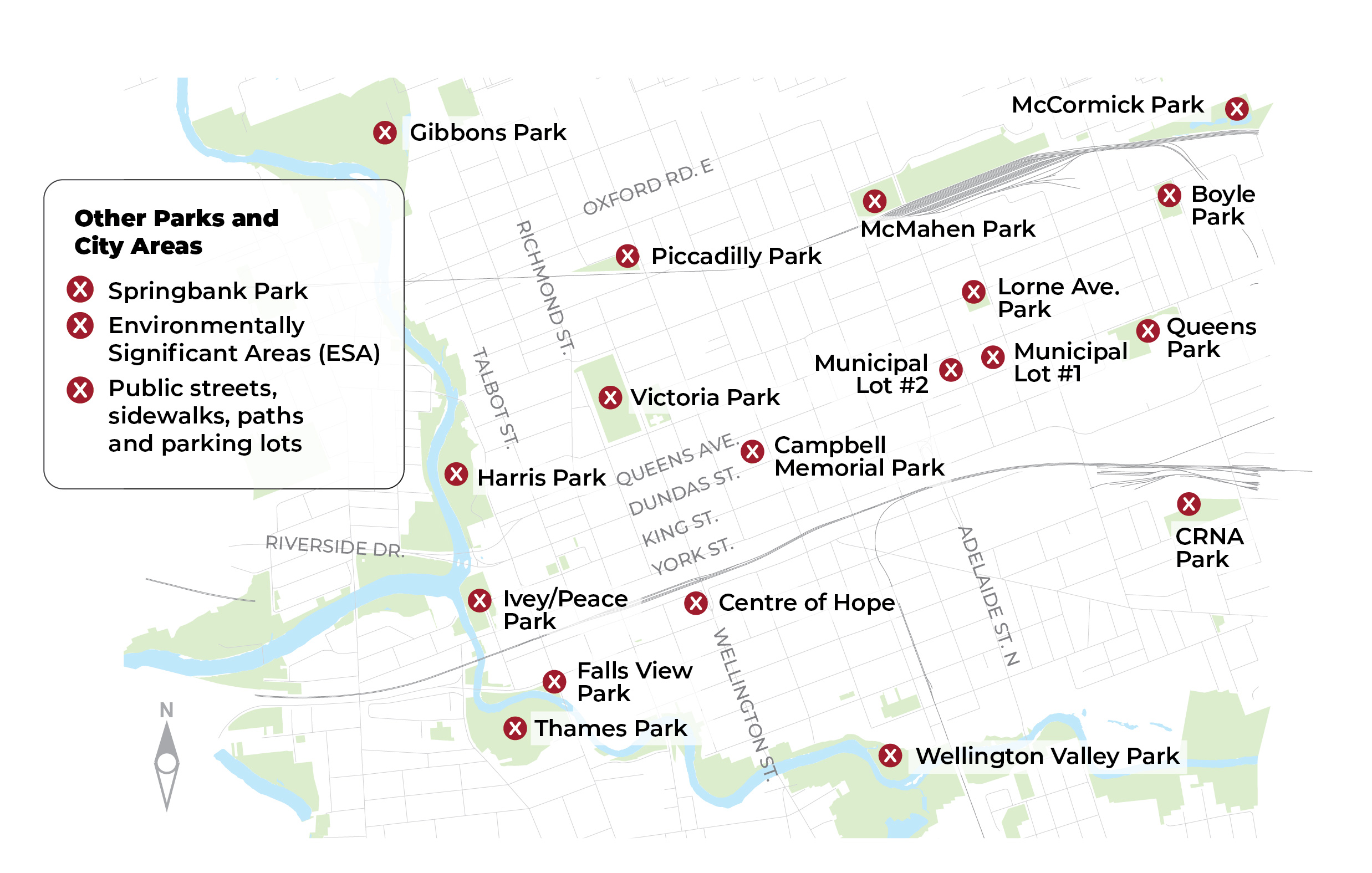
The Downtown Response Team is part of the City of London’s Coordinated Informed Response (CIR). They provide an on-the-ground presence along Dundas Street from the Fork of the Thames to Quebec Street, as well as along Richmond Street from Oxford Street to Dundas Street. The team works proactively with businesses to build relationships, understand ongoing concerns, and support early intervention.
In addition to responding to issues affecting storefronts and shared public spaces, the team regularly checks in with businesses, shares available supports, and connects individuals experiencing homelessness to outreach and social services when needed.
The officers help businesses navigate City services and ensure requests are directed to the right team. They work closely with contracted outreach agencies, City teams, and London Police Service so situations are addressed through one coordinated response.
The Downtown Response Team can also support businesses by offering free Crime Prevention Through Environmental Design (CPTED) audits, which provide practical recommendations related to lighting, visibility, and storefront layout to help reduce safety and security challenges. To learn more about CPTED audits, please email service@london.ca.
The CIR process follows a three-step approach to address encampments while prioritizing safety, dignity, and coordination. When an encampment is identified, the team issues a Notice Order with a cleanup timeline, returns to clear the site and collect any valuable items, and then posts a Receipt of Notice with information on how to retrieve belongings. This process helps ensure a consistent and respectful response to encampments across the city.
When a call or complaint is received, or if the CIR team identifies a bylaw or safety concern, the team will issue a Notice Order. This notice informs individuals of the deadline by which the site must be cleared or when the CIR team will begin cleanup. Each Notice Order includes an occurrence number linked to a specific site. If individuals are not present during the cleanup, they can reference this number to inquire about any items found at the site.
The cleanup timeline depends on the severity of the situation, safety concerns, and the size of the encampment. In most cases, the deadline ranges from 24 to 72 hours. However, if a site poses an immediate safety risk—such as blocking roadways or sidewalks—removal may occur right away.
On the date specified in the Notice Order, the Coordinated Informed Response (CIR) team will return to ensure the site is cleared or that the individual has moved on. The team will assess the area and collect any valuable items left behind. These items will be bagged, labeled with the occurrence number, and stored for 60 days. Individuals who were not present during the cleanup can retrieve their belongings through London CARES outreach. It’s important to note that weapons or items suspected to be connected to criminal activity will be turned over to London Police Service.
After completing a cleanup, the CIR team will issue and post a Receipt of Notice. This document provides information on where individuals can retrieve their belongings if they were not present during the cleanup. The Receipt of Notice includes the same occurrence number as the Notice Order, ensuring a clear record of the site and any collected items.
In addition to supporting individuals living unsheltered, the CIR team assists property owners in addressing challenges related to street-involved individuals on private property.
To comply with privacy regulations, the CIR team can only enter private property with prior consent through the Trespass Agreement Program. Property and business owners can provide consent by contacting the CIR team and London Police Service or by completing the Trespass Agreement Program form using the button below. Once registered, property and business owners will receive a CIR sticker to display in their front window, signalling that the team has permission to enter and assist as needed. For support, contact the CIR team at 519-661-2489.
Learn about the trespass agreement Program
The City of London’s response to encampments is grounded in a human rights-based approach, with a focus on outreach, safety, and long-term housing solutions developed in collaboration with community partners. This includes initiatives like Mobile Service Depots, the Community Encampment Plan, and Coordinated Informed Response.